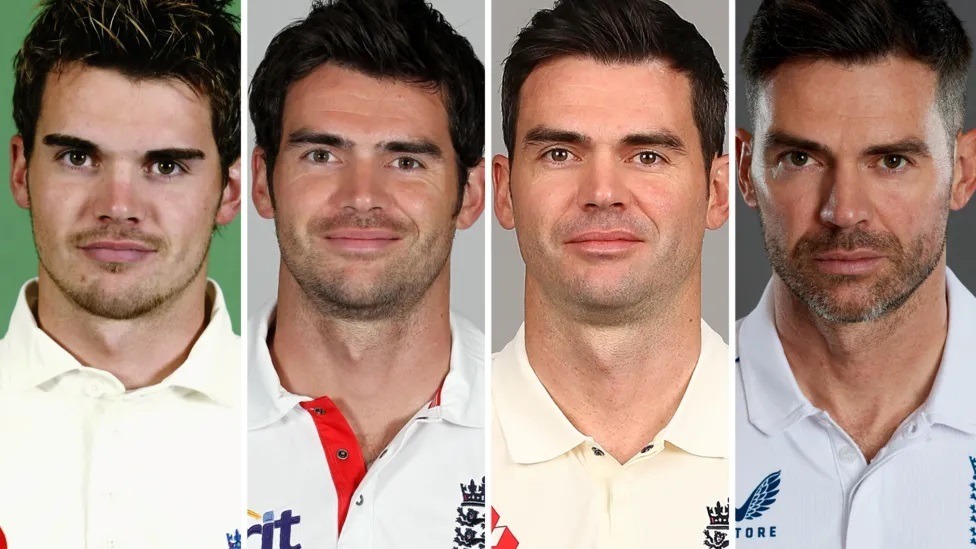
Without us realising, sport can shape and define small parts or huge chunks of our lives.
I bet you know where you were on Super Saturday, when Ben Stokes did what he did at Headingley, or when Andy Murray won Wimbledon.
My dad died in 2005. It was awful, though I mainly remember that year for the Ashes, my own cricket club getting promoted and staying up all night to revise for a university exam after Liverpool won the Champions League, and I’m not a Liverpool fan.
Athletes and players become major characters in our existence. Heroes, influencers and comforters. For more than two decades, James Anderson hasn’t just been England’s guardian of the new ball, but a constant presence at the top of British sport and, therefore, our collective being.
Think what you were doing when Anderson made his Test debut in 2003, or a bit longer ago than that if we want to go back to his first match in an England shirt.
Were you even born? If you were doing your GCSEs, you might now be married with children and an eye-watering mortgage. Can you remember a time when Anderson wasn’t playing for England? If you’re younger than 30, there’s a decent chance you can’t.
In those 20-plus years, Anderson has been carving out a career that would make him a face on English cricket’s Mount Rushmore.
While we were growing older, Jimmy was growing up. Haircuts, stress fractures and 700 Test wickets. Deep in the BBC archive is footage of 20-year-old Anderson at home with his mum Catherine, packing his cricket bag for the tour of Australia in 2002. The next summer, when Anderson made his Test bow against Zimbabwe, a PR expert compared his good looks to David Beckham and suggested he should date a member of Atomic Kitten.
When his England career ends this week against West Indies at Lord’s, a few days off his 42nd birthday, Anderson will be playing for his eighth different Test captain and under his eighth different prime minister.
Consider this. Anderson made his debut before Andrew Strauss, who played 100 Tests and retired in 2012. Later that year, Joe Root made his debut and has won 140 caps. To date, Anderson has spanned the international careers of both men combined.
He has seen it all. Steve Harmison’s wide. Andrew Flintoff’s pedalo. The Zimbabwe crisis. Kevin Pietersen v Peter Moores. Fifty one all out in Jamaica and 517-1 in Brisbane. Textgate. Four Ashes wins and four Ashes defeats, two of them whitewashes. Spot-fixing, Covid and Bazball.
Anderson’s is a story of dedication to the hardest discipline in cricket and one of the most unnatural acts in all sport. The human body is not designed to bowl fast, yet Anderson has done it more times than anyone in the history of the international game.
Sometimes Anderson’s shoulder hurts when he brushes his teeth and the day after a long spell his quads are on fire when he has his first sit-down wee.
No bowler of any kind, let alone fast, is close to playing the 116 Tests Anderson has clocked up past the age of 30. Into his fifth decade, Anderson has been tinkering, trying to add speed to his run-up. Who knows how long he would have tried to go on for had he not been told time’s time.
More important than his longevity is Anderson’s evolution into one of the most complete fast bowlers the game has ever seen. From talented tearaway to a Swiss-army knife of a paceman. Reverse-swing, wobble balls and cutters. A rhythmical approach, grooved action and control of educated fingers. The skills and experience to adapt to all conditions and match situations.
Research by brain scientists suggests that humans don’t fully mature into adults until the age of 30. The same can be said for Anderson the bowler, for the period just after his 30th birthday was his peak.
Between June 2014 and February 2019, Anderson was prolific, claiming 232 wickets in 56 Tests at an average of 21 and strike-rate of 51. He sailed past Lord Botham’s previous England Test wickets record of 383, through 400, 500 en route to becoming the most successful fast bowler the game has ever seen.
As time crept by, the rests became more common, but 600 wickets were reached in an empty stadium in Southampton in 2020. Only on the Ashes tour of 2021-22 – Anderson’s fifth trip down under – did his place as undisputed attack leader come into question, and he and old mate Stuart Broad had to battle back from being dropped for the tour of West Indies at the end of Root’s captaincy.
The Stokes era brought one last hurrah, though whereas Broad surged into retirement, Anderson’s returns have dropped. It was a slow crawl to the 700 mark, but Dharamsala, in the foothills of the Himalayas, was a fitting venue for Anderson to finally scale the fast-bowling mountain.